



Aluminium and steel packaging retain value
long after the label has been read and the product consumed
Durban, 22 September 2026. As packaging manufacturers, brand owners and retailers continue to focus on labelling, traceability, product identification and increasingly sophisticated barcoding technologies, the substrate on which this information appears remains equally important. For metal packaging, its ability to protect products, withstand demanding supply chains and retain value after use makes it an important contributor to South Africa’s transition towards a more circular economy.
According to Dr Kishan Singh, CEO of MetPac-SA, the producer responsibility organisation representing the metal packaging industry, metal packaging should not be regarded simply as waste once its original contents have been consumed.
“Metal packaging has an important advantage in that the material itself retains significant economic and resource value after use. Whether we are talking about a beverage can, food can, aerosol, closure or aluminium tray, the package can become a valuable feedstock for another manufacturing process rather than being lost to landfill,” Dr Singh says.
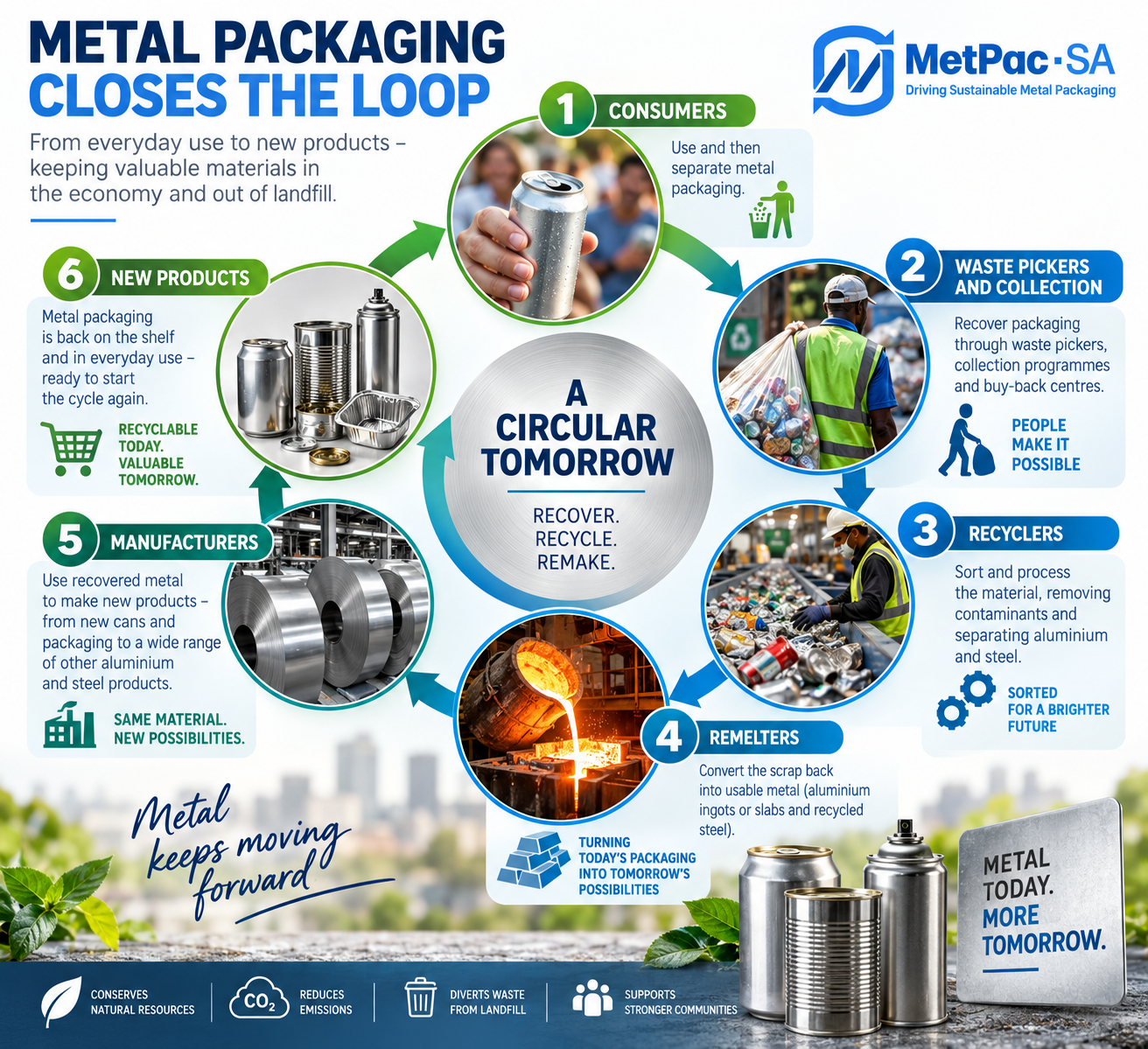
Metal packaging is manufactured primarily from two material groups, i.e. aluminium and tinplate, or ferrous steel. Although both are highly recyclable, they enter different recycling and remelting streams and therefore need to be correctly separated during collection and sorting. The recycling journey essentially follows five stages: collection, sorting, processing, remelting and manufacture into new products.
Aluminium remains a valuable secondary raw material
The aluminium packaging stream encompasses considerably more than beverage cans. It includes used beverage cans, aerosols, foil packaging and trays, wine bottle caps and closures, pharmaceutical collapsible tubes and coffee pods.
Once discarded, these materials enter the recycling chain through waste pickers, collection programmes, buy-back centres and other recovery channels. They are aggregated and sorted, contaminants and non-metal components are removed, and the prepared aluminium scrap is supplied to specialised remelting facilities. There it is converted into aluminium ingots or slabs which can be used as secondary raw material for manufacturing.
Depending on the grade and processing requirements, this recycled aluminium can subsequently be rolled into sheet for new beverage cans and other packaging, or used in the manufacture of a variety of other aluminium products.
“One of aluminium’s strongest circularity credentials is that it can be recycled repeatedly while retaining its inherent material properties. Importantly, recycling aluminium also requires substantially less energy than producing aluminium from primary raw materials. Keeping recovered aluminium in circulation therefore has benefits extending from resource conservation to reducing the environmental impacts associated with primary production,” Dr Singh adds.
Steel packaging benefits from efficient sorting
The ferrous packaging stream includes food cans, general-line cans, paint and polish cans, caps and closures, and steel aerosols. Because steel is ferrous, it can be efficiently separated from aluminium and many other materials through magnetic sorting technology – an important practical advantage within material recovery and recycling systems.
Recovered steel packaging is cleaned, sorted and prepared as scrap before being transported to steelmaking facilities, where it is typically combined with other ferrous scrap and remelted. The resulting recycled steel can be used in products such as reinforcing bar, structural steel and other applications. Where appropriate technology, material quality and market demand exist, recovered steel can also contribute to the manufacture of new steel sheet and packaging.
“This illustrates why packaging design and the systems surrounding a package should increasingly be considered together. Labelling, coding and branding technologies are essential to the modern packaging industry, but we also need to keep the end-of-life journey of the complete pack firmly in mind. Every component of a packaging system should support, rather than unnecessarily complicate, effective recovery, sorting and recycling,” Dr Singh explains.
A value chain responsibility
MetPac-SA emphasises that circularity cannot be achieved by recyclers alone. Consumers and waste pickers need to recover packaging; collectors and buy-back centres must aggregate it; recyclers must sort and process it; remelters convert the scrap back into usable metal and manufacturers create demand by using recovered material in new products. This makes collaboration across the packaging value chain increasingly important.
By moving aluminium and steel packaging from collection through sorting and remelting and ultimately back into manufacturing, recycling keeps valuable resources circulating in the economy. It reduces reliance on virgin raw materials, supports greater resource efficiency and diverts recyclable material from landfill – principles that are central to building a more circular packaging economy in South Africa.
“The future of packaging will not only be about what we place on the shelf or what information we communicate through a label or barcode. We also have to consider what happens to that package once the consumer is finished with it. Effective packaging needs to perform throughout its entire life cycle,” Dr Singh concludes.
For more information, visit www.metpacsa.org.za
