



Pilot application details: Click
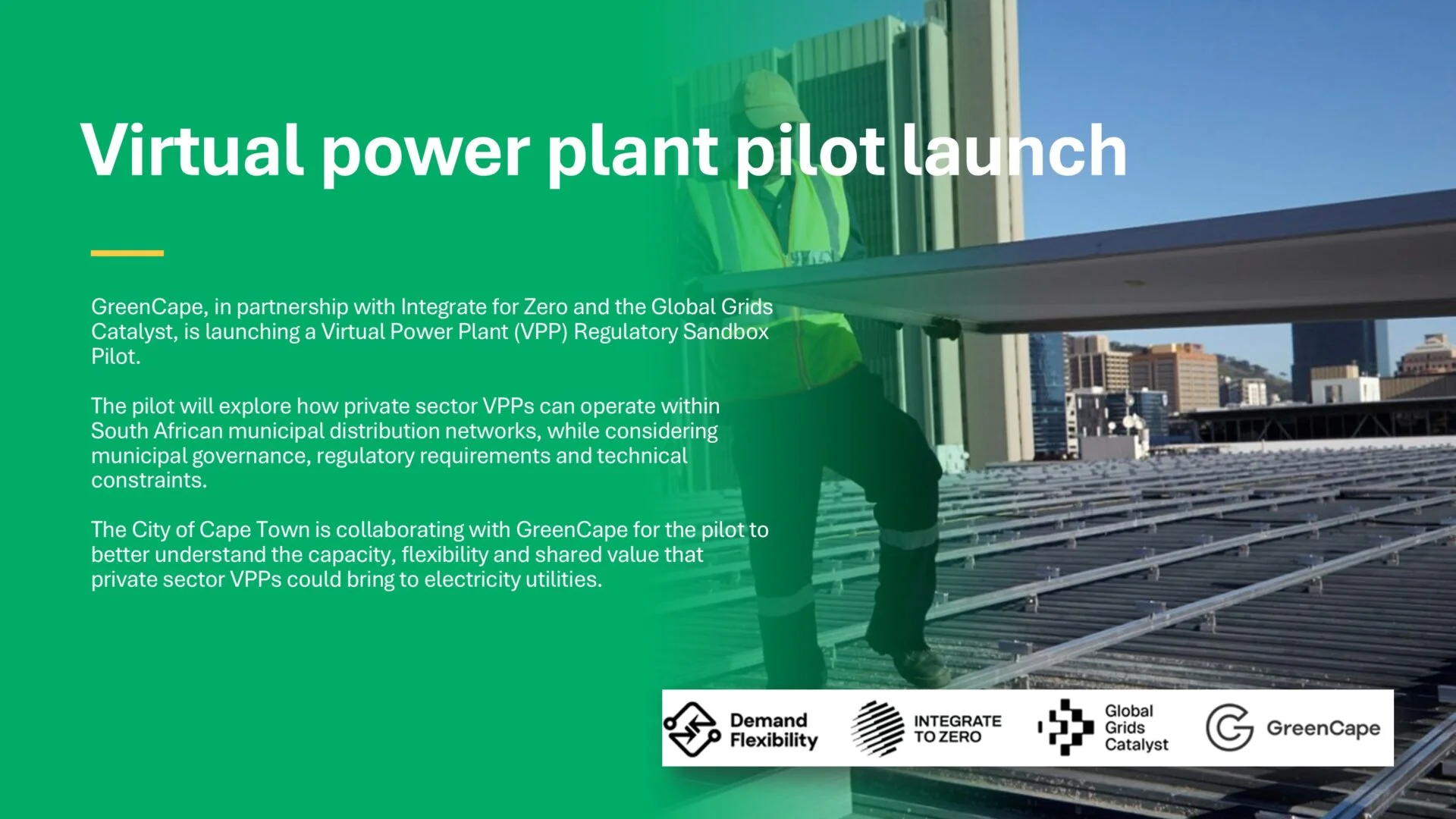
GreenCape, in partnership with Integrate to Zero and the Global Grids Catalyst, invites interested Virtual Power Plant (VPP) companies to submit an application to participate in a Regulatory Sandbox Pilot. The pilot will explore how private sector VPPs can operate within South African municipal distribution networks, while considering municipal governance, regulatory requirements and technical constraints. The City of Cape Town is collaborating with GreenCape for the pilot to better understand the capacity, flexibility and shared value that private sector VPPs could bring to electricity utilities.
With South Africa hosting over 6 GW of distributed generation assets and smart appliances, the project aims to aggregate underutilised customer-side resources, such as rooftop solar, residential battery storage, and smart devices, into a coordinated system that functions as a flexible, on-demand power resource to support the local electricity grid.
Glen Tyler-Davies from PIE said: “This project holds great potential, with business, government and philanthropy coming together to back the same goal: a more reliable, affordable and cleaner electricity system for South African households.”
Operating within the City of Cape Town’s distribution grid, the pilot provides a controlled sandbox environment to test key virtual power plant use cases, focusing primarily on shifting peak electricity consumption into off-peak periods. The lessons learned will directly inform the City of Cape Town and other South African municipalities on how to structure VPP frameworks, contract third-party aggregators, and design fair incentive models for distributed energy resources. The pilot supports the City of Cape Town’s 2050 Energy Strategy, which outlines a clear roadmap to build a future-fit energy utility, with lower cost, lower carbon and more reliable energy. “The City’s Energy Directorate has established itself as a progressive and innovative player in the energy transition, particularly as a leader in enabling distributed energy resources, with a strong uptake of rooftop solar and growing participation in our feed-in programme.
Almost 2000 Small-Scale Embedded Generation feed-in customers have received credits totalling near R9m (incentives included) by exporting excess electricity to the grid. The Virtual Power Plant Regulatory Sandbox Pilot is a natural next step, helping us explore how customer-owned energy resources such as solar, batteries and smart devices can work together to support a more resilient, affordable and efficient energy system. The lessons from this pilot will help inform future market frameworks and strengthen the City’s journey towards a future-fit, multi-player energy utility. I wish to thank Alderman James Vos, the City’s Mayoral Committee Member for Economic Growth for his support of this initiative which holds great potential for boosting the local economy. His efforts to unlock Cape Town’s green economy and opening markets for entrepreneurs remains significant,” said Mayoral Committee Member for Energy, Alderman Xanthea Limberg.
Highlighting the significance of this initiative for the local economy and energy sector, Alderman James Vos noted: “We want to position Cape Town as a leading green economy on the continent, and this initiative is a great example of how we work with partners like GreenCape and the private sector to unlock new markets and economic opportunities. This is the kind of innovation and collaboration that will help shape the future economy of Cape Town.”
Dan Hamza-Goodacre, Chief Energy Officer at Integrate to Zero puts the Cape Town sandbox in a global context: “Around the world countries are setting targets for the contribution that VPPs and demand flex can make to cleaner, more affordable electricity grids. The technology is here but to unlock benefits the rules need to change to allow VPP and demand flex solutions to compete on a level playing field with historical ways of powering the grid.”
Eric Wanless, Grid Systems Director at Global Grids Catalyst notes that: “Municipalities like the City of Cape Town are in a unique position to define and test the role that VPP’s can play globally in reducing cost while increasing reliability and resilience.”
Pilot application details
- Target participants: A minimum of one and a maximum of four VPP providers will be selected to participate in the pilot.
- Initial scale: The initial phase anticipates onboarding approximately 150 homes to showcase proof-of-concept value propositions, primarily using residential battery energy storage.
- Incentive funding: Successful applicants will be eligible for incentive funding across two pools: A primary pool for peak-to-off-peak energy shifting, and a secondary pool for secondary use cases (such as instantaneous dispatching, voltage control, and ancillary services) as well as technical infrastructure enablement (such as City-approved AMI meters).
- Key timelines:
- 15 November 2026: Submissions close
- 30 November 2026: Appointment of panel of participants
- December 2026 – January 2027: Setup and technical testing phase
- February 2027 – September 2027: Active incentive run
- Interested VPP providers can access the submission details here. Applications are due by 15 November 2026.
